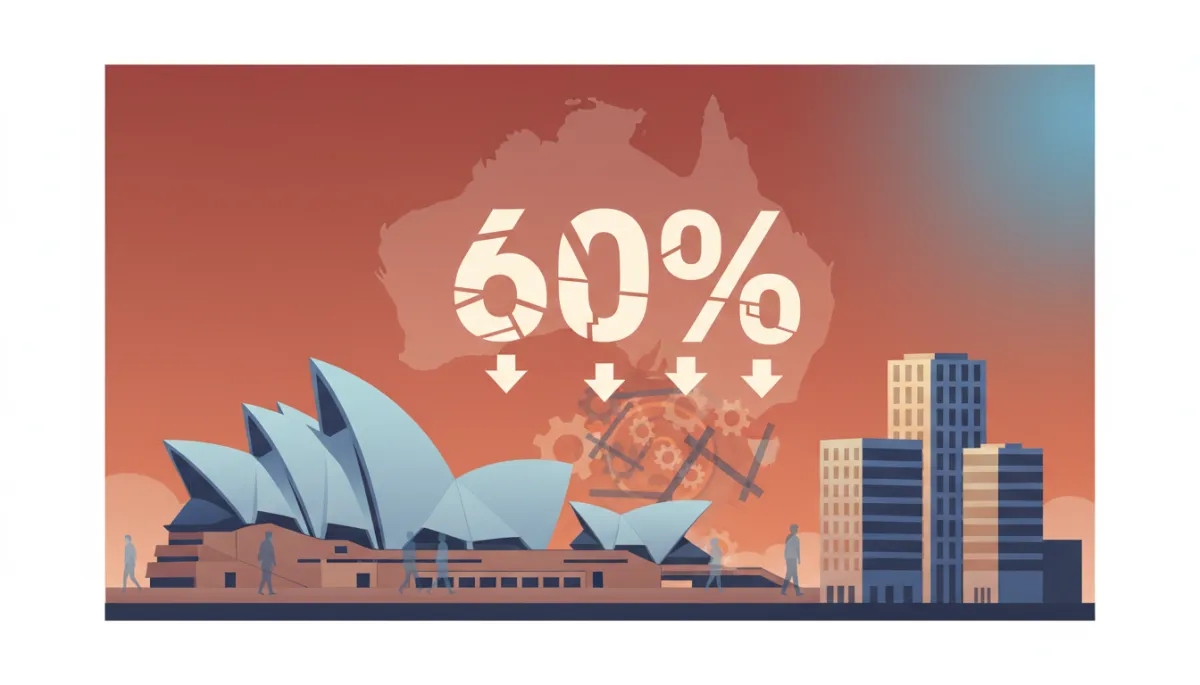
Why 60% of New Aussie Real Estate Agents Quit
Australian Real Estate, Agent Attrition, Coaching & Consulting
June 2026: Why 60% of New Australian Real Estate Agents Leave Before Year Two
In June 2026, the Australian Real Estate sector is booming on paper, yet quietly bleeding people. Around 60% of new Real Estate Agents disappear before their second year. For coaches and consultants, this is not just a statistic; it is a structural opportunity hiding in plain sight.
The 60% Problem: What’s Really Going On?
Hard national numbers on Australian agent attrition are scarce, but international benchmarks paint a clear picture. U.S. data suggests around 75% of new agents fail in their first year and nearly 87% are gone within five years. It is reasonable to infer that Australian Real Estate follows a similarly brutal curve, especially in highly competitive metro markets and commission-only environments.
When you talk to principals and franchise leaders, they will often explain this churn with familiar stories: “They just weren’t hungry enough,” “Not everyone is cut out for sales,” or “Real Estate is a tough gig.” These narratives frame Agent Attrition as a talent issue, a kind of natural selection where only the strongest survive. But for coaches and consultants working closely with new agents, the pattern looks very different. The majority of those who leave are not lazy or incapable; they are under-resourced, under-structured, and overwhelmed by an industry model that assumes they can build a business with almost no scaffolding.
It’s Not a Talent Problem – It’s a Structure Problem
Look closely at how most Australian Real Estate offices are set up. A new agent is recruited with big promises: flexible income, uncapped commissions, a “supportive team.” After a short induction on legislation and compliance, they are handed a desk, a CRM login, and a phone – and then left to “prospect.” There is rarely a clear 90-day plan, a tested daily schedule, or a structured pathway from rookie to consistent performer. The Industry Structure assumes that if you throw enough people at the wall, a few will stick and become top producers.
For coaches and consultants, this is the central Real Estate Challenge: the system is optimised for selection, not development. New agents face:
Unclear success pathways: No concrete roadmap from “no listings” to a sustainable pipeline within 6–12 months.
Fragmented learning: One-off training days without ongoing coaching, implementation support, or accountability structures.
Financial pressure: Commission-only or low retainer models that demand results before skills and systems are in place.
Role confusion: New agents are expected to be lead generators, marketers, negotiators, and admin staff from day one.
When 60% of your new hires leave before year two, it is not a “people problem”; it is a design flaw. Effective Agent Retention Strategies start with redesigning the environment, not blaming the individuals who fail to thrive in it.
Why the Industry Is Reluctant to Fix the Structure
If the problem is so obvious, why does the Industry Structure stay largely unchanged? In conversations across Australian Real Estate offices, three themes keep surfacing – and they are exactly where coaches and consultants can add value.
Short-term economics: Many agencies quietly rely on a “churn and burn” model. Recruiting waves of new Real Estate Agents costs money, but it also generates short-term listings, database growth, and brand reach. Investing heavily in long-term development and retention looks expensive compared to simply hiring the next hopeful recruit.
Cultural narratives: The heroic lone-wolf agent is still the dominant story. Structural support is seen as “hand-holding,” and many leaders who survived the old model believe others should too. This mindset makes it easy to dismiss attrition as a talent issue rather than a Real Estate Challenge created by the business model itself.
Lack of operational design expertise: Most principals are great listing agents, not organisational architects. They know how to win business personally, but not how to build replicable systems that turn rookies into consistent performers. That gap is precisely where external coaches and consultants can lead.

Well-designed onboarding and coaching programs can cut early agent attrition dramatically.
Where Coaches and Consultants Can Move the Needle
For professionals who support agencies, this moment in June 2026 is a strategic opening. The market is tightening, technology is accelerating, and the cost of losing each agent – often estimated between AUD 15,000 and 50,000 in recruitment, training, and lost productivity – is becoming impossible to ignore. You can position your services not as “nice-to-have training” but as a structural solution to Agent Attrition.
High-impact Agent Retention Strategies for Australian Real Estate right now include:
Designing a 12–18 month success pathway: Map the exact skills, activities, and milestones a new agent needs from day one to year two, and turn that into a visual, trackable framework for both leaders and agents.
Embedding rhythm and accountability: Weekly coaching huddles, daily activity targets, and structured feedback loops convert theory into behaviour. This is where many off-the-shelf training programs fail – they teach but do not embed.
Rebuilding roles and teams: Instead of every agent doing everything, help agencies experiment with pod structures, shared assistants, and internal transfers. International data shows internal moves often retain around 89% of agents after 12 months, compared with about 76% for external hires.
Addressing financial runway: Work with principals to create realistic cash-flow plans for new agents, blending salary, retainer, or staged commission models so they are not forced out before they gain traction.
📌 Key Takeaway: When you shift the conversation from “fixing underperforming agents” to “redesigning the system they operate in,” your consulting offer becomes strategic, not remedial.
Turning Attrition into a Strategic Advantage
The fact that roughly 60% of new Real Estate Agents leave before their second year is not an inevitable law of nature. It is the predictable outcome of an Industry Structure that treats people as expendable and success as a solo sport. For coaches and consultants in Australian Real Estate, the opportunity in 2026 is to help agencies rewrite that script – to build environments where new agents are not just recruited, but genuinely developed.
Agencies that embrace structural change now – clear pathways, stronger support, smarter team design – will not only reduce Agent Attrition, they will also build deeper loyalty, stronger brands, and more resilient businesses. Those that cling to the old model will keep losing 60% of their rookies and blaming “talent” for a problem that has always been structural.
Your role, as a coach or consultant, is to make that structural gap visible – and then help close it. In a market where most competitors are still selling motivation and scripts, the real differentiator is your ability to redesign how Australian Real Estate Agents are supported from day one to year two and beyond.
